
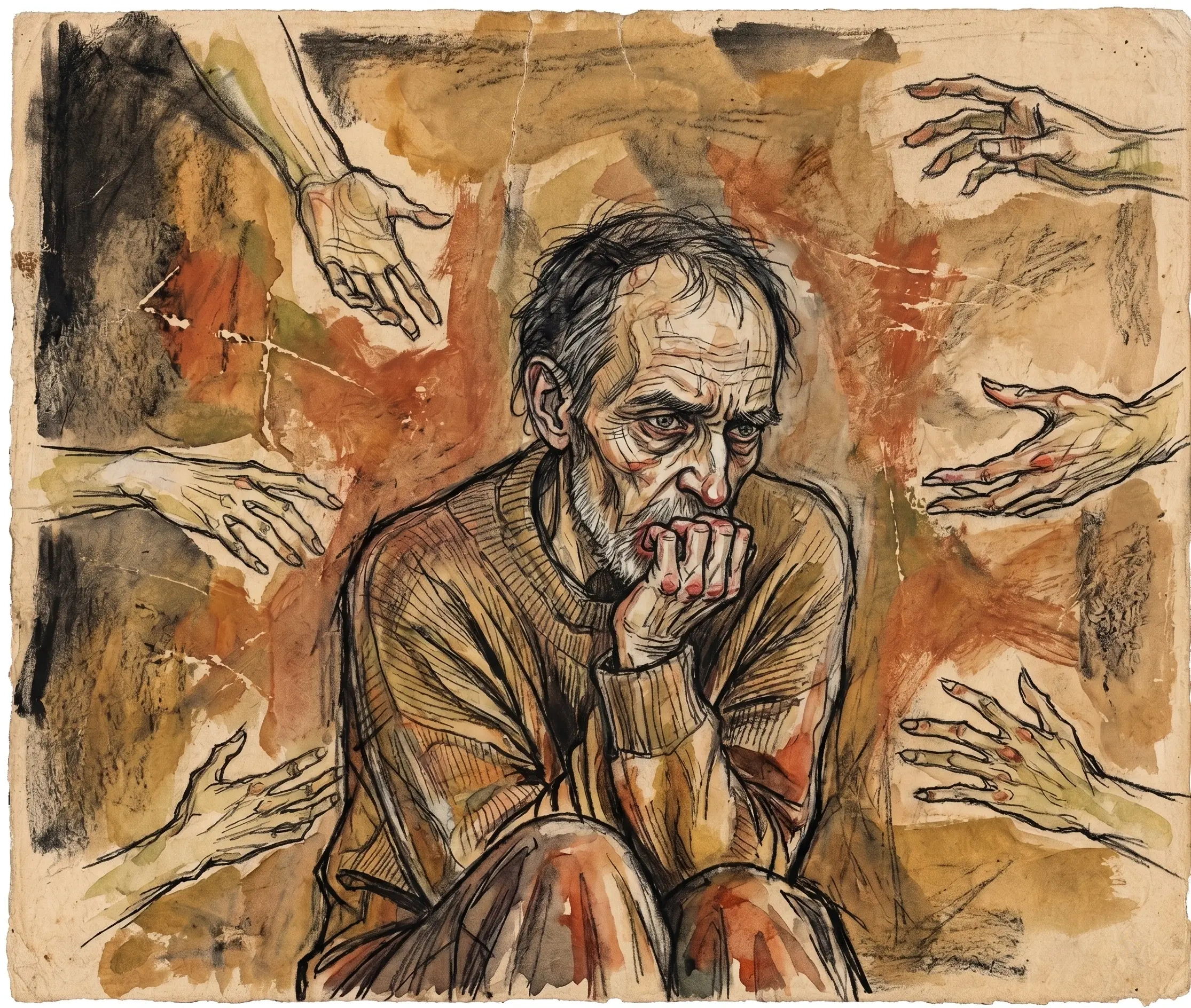
Feeling responsible for other people’s feelings usually starts long before you notice it happening. A partner goes quiet, a friend’s text lands a beat too flat, a parent sighs on the phone, and something in you moves before you have had time to ask what is going on. Feeling responsible for other people’s feelings is the habit of treating someone else’s emotional state as a problem you are obliged to solve.
From the outside it can look like being a good listener, a steady presence, the one everyone leans on. From the inside it can feel more like never being off duty.
Key takeaways
- Chronic responsibility for other people’s feelings is often better understood as a defence than as kindness taken too far, though the traditions describing it disagree about the underlying mechanism.
- Family systems theory links the pattern to a blurred line between your feelings and someone else’s, an association supported by a large review that was explicit the evidence is mostly correlational rather than causal.
- Attachment researchers describe a related pattern, compulsive caregiving, in which giving care substituted for receiving it in childhood, leaving an adult who gives easily and asks with difficulty.
- Caretaking is not automatically harmful; a review of parentification research found that reciprocal, acknowledged and age-appropriate caregiving can sit alongside genuine closeness.
- Terms like codependency and the fawn response are widely used clinically but neither has settled formal scientific status, so both are better held as descriptions than as diagnoses.
Contents
- Why do I feel responsible for other people’s feelings?
- What does emotional caretaking look like day to day?
- Where does feeling responsible for other people’s feelings come from?
- What does being responsible for other people’s feelings cost you?
- Is it always a problem to care this much?
- How do you start feeling less responsible for other people’s feelings?
Why do I feel responsible for other people’s feelings?
Because at some point it worked. Several strands of psychological thinking, arriving from very different directions, converge on the idea that chronic responsibility for other people’s feelings is not a habit you chose but an old solution to an old problem, still running.
That framing matters because it changes what kind of thing this is. Not a character flaw, not niceness that got out of hand, but an adaptation that once made sense in a specific relationship and has since generalised to relationships that no longer require it. The traditions differ on the mechanism, and that disagreement is worth keeping rather than smoothing over.
What does emotional caretaking look like day to day?
Emotional caretaking shows up in small, unremarkable moments rather than dramatic ones. Saying “sorry, that’s on me” before you know what actually happened. Going quiet in a disagreement not because you have changed your mind, but because staying quiet feels safer than staying in it.
Checking your phone late at night after a tense exchange, not to see how you are doing, but to see how they are. Being able to list exactly what upset the people around you today, and drawing a blank when someone asks what you feel.
None of these mean much on their own. Together, over years, they add up to a particular kind of tiredness, not the tiredness of doing too much, but the tiredness of vigilance that never switches off.
Where does feeling responsible for other people’s feelings come from?
Three traditions offer three different answers, and they point in three different directions for change. Feeling responsible for other people’s feelings has been traced to a blurred boundary between self and other, to a childhood in which giving care was the reliable route to closeness, and to a self that formed around anticipating what a caregiver wanted.
| Tradition | What it says drives the pattern | Where it points for change |
|---|---|---|
| Family systems | A blurred line between your feelings and theirs | Rebuilding a separate self while staying in contact |
| Attachment | Care-giving learned as the only route to closeness | Relearning how to receive, not only give |
| Psychodynamic | Your own needs and anger felt unsafe to show | Making room for what sits under the caretaking |
The family systems account
Murray Bowen described a quality he called differentiation of self: the degree to which a person can stay emotionally connected to someone without losing the line between that person’s feelings and their own. At the low end of that scale, sometimes called fusion, the boundary blurs, and another person’s distress does not merely register. It becomes yours to resolve, the way two glasses of water poured into one jug can no longer be told apart.
A 2021 review of nearly 300 studies found reasonably consistent support for differentiation of self predicting psychological and relational health, while stating plainly that most of the evidence is correlational and that longitudinal research remains thin (Calatrava et al., 2021). One study found that fusion, more than couple satisfaction itself, predicted codependent behaviour (Lampis et al., 2017).
The attachment account
Some children learn early that giving care is the reliable way to stay close to a parent, and that receiving care is not consistently available. West and Keller described this as compulsive caregiving: an adult attachment pattern in which a person emphasises giving care over receiving it, because in childhood caregiving was what kept the relationship intact (West & Keller, 1991).
It works like a door that stayed open when others did not. You learn to use that door constantly, and years later you may still be using it in relationships that have other doors, because giving is the only language of closeness you were taught fluently.
A related idea, parentification, describes children who took on emotional support for a parent well before it was developmentally theirs to carry. John Byng-Hall traced how this develops inside insecure attachment relationships and distinguished it from the one-way, unacknowledged version that tends to cause lasting harm (Byng-Hall, 2002).
The psychodynamic account
Donald Winnicott described a false self that forms when a child’s spontaneous needs are not reliably met: a compliant, attentive self organised around anticipating what a caregiver wants, at real cost to contact with one’s own wants underneath.
Some clinicians extend this, reading chronic caretaking as a way of managing guilt about one’s own anger toward people one loves, so that caring functions partly as ongoing atonement for a feeling that was never expressed. This connects to established psychodynamic thinking about guilt and self-punishment, but the specific link to caretaking is clinical inference rather than a directly studied finding, and is worth holding loosely.
What does being responsible for other people’s feelings cost you?
The cost lands in two places: contact with your own feelings, and the honesty of the relationship. When attention is chronically pulled toward managing someone else’s internal state, less attention remains for noticing your own, so wants get quieter and irritation gets swallowed rather than spoken.
Swallowed feelings do not disappear. They tend to resurface as resentment, or as a flat exhaustion that is hard to explain to anyone, including yourself.
The relational cost is subtler. Closeness depends on being known, on someone having an accurate, current picture of what you actually feel. A relationship organised around managing another person’s feelings can look close from the outside while functioning underneath more like vigilance than mutual knowing. It is possible to be deeply entangled with someone and still feel unseen inside that entanglement.
Is it always a problem to care this much?
No, and the research is fairly clear on this point. A 2022 review synthesising 61 studies of parentification found real evidence that taking on care for someone else is not automatically harmful, and identified conditions under which it can be adaptive (Masiran et al., 2022).
What seems to matter is not the caretaking itself but its terms. Where a caregiving role is acknowledged, roughly fair, age-appropriate and reciprocated over time, it can sit alongside genuine closeness. Where it is compulsory, one-directional and unnamed, the costs described above become more likely.
Context shifts this too. In families where obligation to parents is a moral good rather than a negotiable preference, the same behaviour carries different meaning, and naming it as a problem costs more. That is worth weighing rather than overriding.
How do you start feeling less responsible for other people’s feelings?
Not by caring less. Feeling less responsible for other people’s feelings is closer to what Bowen meant by differentiation: staying close to someone while still being able to locate, and say, what is actually yours.
Not the water spilling out of your glass into theirs, and not theirs into yours. Two people, close enough to touch, each still holding their own.
That is a slow shift rather than a single decision, and it tends to start small: noticing the reflex before acting on it, naming a feeling before managing someone else’s, letting a silence sit a beat longer than is comfortable. None of that undoes years of a pattern that once made real sense. But it points somewhere more sustainable than the alternative: not doing less for the people you love, but counting yourself among the people whose feelings register.
Common questions
Am I codependent, or just a caring person?
Codependency has no formal diagnostic status, despite decades of clinical use since it was described in the addiction treatment field (Cermak, 1986). The more useful question is not which label fits but whether your caretaking is reciprocated and chosen, or one-directional and compulsory. That distinction has better research behind it than the label does.
Is the fawn response a real diagnosis?
No. The fawn response, chronic appeasement described as a fourth trauma response alongside fight, flight and freeze, comes from clinical practice writing rather than peer-reviewed research (Walker, 2013). Many people find it a useful name for something real in their experience. It is best treated as description rather than as an established scientific category.
Does this mean I should stop helping the people I love?
No. Nothing in this material suggests withdrawing care, and the parentification research points the other way: acknowledged, reciprocal caregiving can coexist with real closeness (Masiran et al., 2022). The concern is care that runs in one direction only, is never named, and leaves no room for your own needs to surface.
What if the person really does need my help?
Then they need it, and that is a real situation rather than a pattern. The question worth asking is whether you can also say what you feel while helping, or whether helping is the only position available to you. Difficulty with the second part is what the research describes, not the helping itself.
References
Byng-Hall, J. (2002). Relieving parentified children’s burdens in families with insecure attachment patterns. Family Process, 41(3), 375–388. https://doi.org/10.1111/j.1545-5300.2002.41307.x
Calatrava, M., Martins, M. V., Schweer-Collins, M., Duch-Ceballos, C., & Rodríguez-González, M. (2022). Differentiation of self: A scoping review of Bowen Family Systems Theory’s core construct. Clinical Psychology Review, 91, 102101. https://doi.org/10.1016/j.cpr.2021.102101
Cermak, T. L. (1986). Diagnosing and treating co-dependence: A guide for professionals who work with chemical dependents, their spouses, and children. Johnson Institute Books. ISBN 978-0935908329.
Lampis, J., Cataudella, S., Busonera, A., & Skowron, E. A. (2017). The role of differentiation of self and dyadic adjustment in predicting codependency. Contemporary Family Therapy, 39(1), 62–72. https://doi.org/10.1007/s10591-017-9403-4
Masiran, R., Ibrahim, N., Awang, H., & Lim, P. Y. (2023). The positive and negative aspects of parentification: An integrated review. Children and Youth Services Review, 144, 106709. https://doi.org/10.1016/j.childyouth.2022.106709
Walker, P. (2013). Complex PTSD: From surviving to thriving. Azure Coyote Publishing.
West, M. L., & Keller, A. E. R. (1991). Parentification of the child: A case study of Bowlby’s compulsive care-giving attachment pattern. American Journal of Psychotherapy, 45(3), 425–431. https://doi.org/10.1176/appi.psychotherapy.1991.45.3.425
Winnicott, D. W. (1965). Ego distortion in terms of true and false self. In The maturational processes and the facilitating environment: Studies in the theory of emotional development (pp. 140–152). International Universities Press. (Original work published 1960)