
Ho Chi Minh City: a process group
A process group is group psychotherapy for personal growth and change. Eight people meet regularly with a psychologist and work with what happens between them — offering each other support, honest feedback, and perspectives you will not arrive at alone, in a setting safe enough to use them.
- Maximum 8 members
- English-speaking adults
- One weekend a month, in person at Saigon Pearl
Three hours of therapy on Saturday and three hours on Sunday, once a month.

How does a process group work?
A small group — a maximum of eight — meets regularly with a psychologist. There is no topic and no curriculum: no worksheet, no theme for the month, no exercise to complete. The material is what happens between you in the room: what you feel when someone speaks, what you decide not to say, who you find yourself watching, what happens to you in the silence.
Who it is for
The circle is for English-speaking adults living in Ho Chi Minh City: people who have relocated here, Vietnamese professionals who work in English, and people who have come back after years abroad.
Most members arrive with some version of one of these
- relationships that keep taking the same shape and ending the same way
- loneliness that does not lift with more social contact
- a distance from other people that persists even with the people you are closest to
- trouble with anger, or trouble finding any
- the same feedback at work, from different people, that you have never understood
- wanting to be known rather than managed
What the circle asks of you is more specific than what it asks about you. You need to be willing to say what is true in the moment, to hear how you affect other people without treating it as an attack, and to stay in the room when it is uncomfortable. Nobody arrives able to do this. It is the thing being learned.
What you’ll gain
- you notice what you are feeling nearer to when you are feeling it
- you say difficult things earlier and more plainly, so they cost less
- other people’s reactions stop being either proof of something about you or noise
- conflict becomes something that can be survived and repaired rather than avoided or won
- you are less alone in a way that does not depend on being liked
Group therapy has strong outcome evidence for depression, social anxiety and interpersonal difficulties, and performs comparably to individual therapy across most presentations. Reviewing the meta-analytic evidence in the American Journal of Psychotherapy, Rosendahl, Alldredge, Burlingame and Strauss (2021) found the group and individual formats of the same treatment to be essentially equivalent, with large effects for depression and social anxiety against untreated controls. That is what the research can tell you. What it cannot tell you is whether this particular circle is right for you, which is what the screening is for.
Joining and commitment
Members join as places open and stay as long as the work is useful — no start date, no end date, no set number of months. Because the circle meets monthly, the commitment is one month: a single weekend, after which you decide whether to continue. The fee is 1,400,000 VND for that weekend — four sessions of 90 minutes, and a fraction of what the same six hours would cost in individual therapy.
Everyone begins with a screening — one to three individual sessions of 45 minutes. It is not an assessment you pass. We work out what you want from the circle, and I explain how group therapy works, including confidentiality and what members are expected to do. Deciding it is not for you is a good outcome, and nothing is committed until the screening is done.
Key facts
- Service: monthly in-person process group for English-speaking adults
- Location: Saigon Pearl, Binh Thanh, Ho Chi Minh City. The address is given after screening.
- Format: in person
- When: one weekend a month, three hours on Saturday and three hours on Sunday
- Session length: six hours across the weekend, run as two sessions each day
- Group size: maximum 8 members
- Minimum commitment: one month
- Joining: a screening of one to three individual sessions of 45 minutes
- Fee: 1,400,000 VND per weekend — four sessions of 90 minutes
- Language: English (facilitator is bilingual English/Vietnamese)
- Facilitator: Hieu Tran, clinical psychologist licensed in Norway (HPR 10136421), trained in group analysis
- Booking: email info@hieutrangoc.vn or WhatsApp
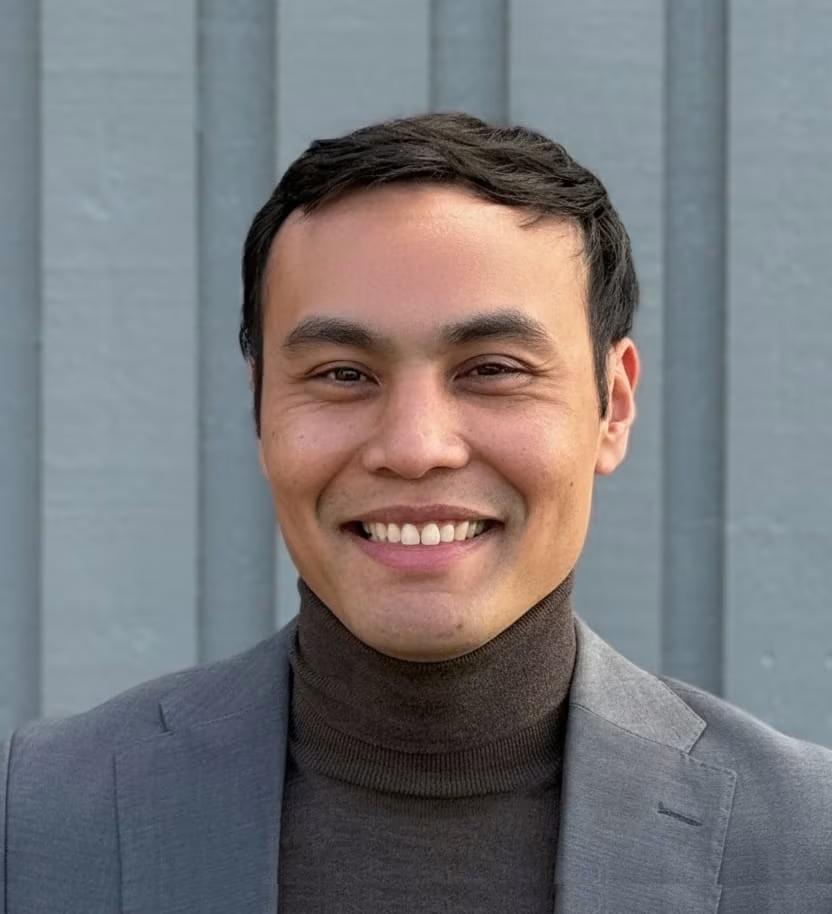
About the group therapist
The circle is facilitated by clinical psychologist Tran Ngoc Hieu. Vietnamese, trained and licensed in Norway, now practising in Ho Chi Minh City. He holds a Cand.Psychol. (Psy.D.) in Clinical Psychology from the University of Bergen and is registered with the Norwegian Psychological Association and the European Federation of Psychologists’ Associations (EFPA). His clinical experience spans inpatient psychiatry, university hospitals, and private practice.
Working across both Vietnamese and international contexts shapes how he understands what clients bring: family expectation, obligation, and the particular strain of living between two sets of cultural assumptions are familiar territory rather than something to be explained from scratch.
His work is shaped by the conviction that lasting change happens through relationship, not just reflection.
Related reading
Why a group, and not just individual therapy
Longer pieces on how group work actually operates, where the method comes from, and who tends to find it useful.
What a group does that one-to-one cannot
The mechanisms that only appear in a room with other people, and why loneliness rarely resolves in private.
Reading other people accurately
Mentalizing is a skill, not a trait. A group is where you find out how good your guesses actually are.
Where this method comes from
Group analysis from Foulkes and the Northfield experiments to now. The tradition this group is run in.
Successful and quietly alone
Functioning well, well regarded, and without anyone who knows what the week has actually been like.
Questions
Frequently asked questions
What is a process group?
A circle with no set topic, where the material is what happens between the members while they are together. The word process refers to how people relate in the room, as opposed to the content of what they report about their lives outside it. It is a standard format in group analysis and group psychotherapy.
How is this different from a support group?
Many people arrive here having searched for a support group in Ho Chi Minh City, so the distinction is worth making plainly. A support group is usually peer-led, organised around a shared problem, and aimed at encouragement and shared information. This is psychotherapy: it is led by a licensed clinical psychologist, it works on relational patterns rather than a single presenting issue, and it is aimed at lasting change rather than getting through the week.
Is this the same as a circle?
Yes. Circle is the word this page uses for it, and it is what most people call a group that meets to speak honestly together. Process group is the clinical name for the same thing: no set topic, and what happens between the members is the material. What separates it from a men’s circle, a women’s circle or a sharing circle is that this one is facilitated by a licensed clinical psychologist and run as psychotherapy.
Where in Ho Chi Minh City does the circle meet?
In a private room at Saigon Pearl in Binh Thanh. The exact address is given to members after screening, which is how the circle protects the privacy of the people in it.
Why a whole weekend instead of an hour a week?
Because six hours across two days does something an hour a week cannot. Work that would be interrupted by the clock can be finished, and material that surfaces on the first day has a night to settle before the circle returns to it. It also asks less of a working week: one weekend a month is easier to protect than a fixed evening every week.
Is group therapy as effective as individual therapy?
For most presentations the outcome research shows the two perform comparably, and group work has particular strengths for social anxiety and interpersonal difficulties, where the problem is easier to reach when other people are actually present.
What if I do not know what to say?
Almost everyone starts there. Not knowing what to say is itself something to say, and it is usually more useful than a prepared account. Sessions have no agenda, so nothing is expected of you on any given weekend other than being honest about where you are.
Will I have to talk about my past?
Only where it is relevant to what is happening now. The circle works mainly in the present tense, on what is going on between the people in the room. The past tends to arrive on its own, in the way you relate to other members.
Is what I say confidential?
Yes. Confidentiality is the circle’s central agreement, and it is covered fully during screening. Members agree not to discuss what other members say outside the room, and not to seek each other out socially while the circle runs.
Do I need to be fluent in English?
The circle works in English, but perfect fluency is not required. Vietnamese is welcome when it is the only word that will do.
How much does group therapy cost?
1,400,000 VND for the weekend: four sessions of 90 minutes, six hours of therapy in total. Because the circle meets one weekend a month, that is what a month costs. Group therapy costs a fraction of individual therapy for the same amount of clinical time, which is one of the reasons it is a realistic option for longer-term work.
Can I be in individual therapy at the same time?
Yes, and many members are. If you already have an individual therapist, it helps if they know you are joining a circle. Some people use the circle as their main therapy and others use it alongside individual work.