
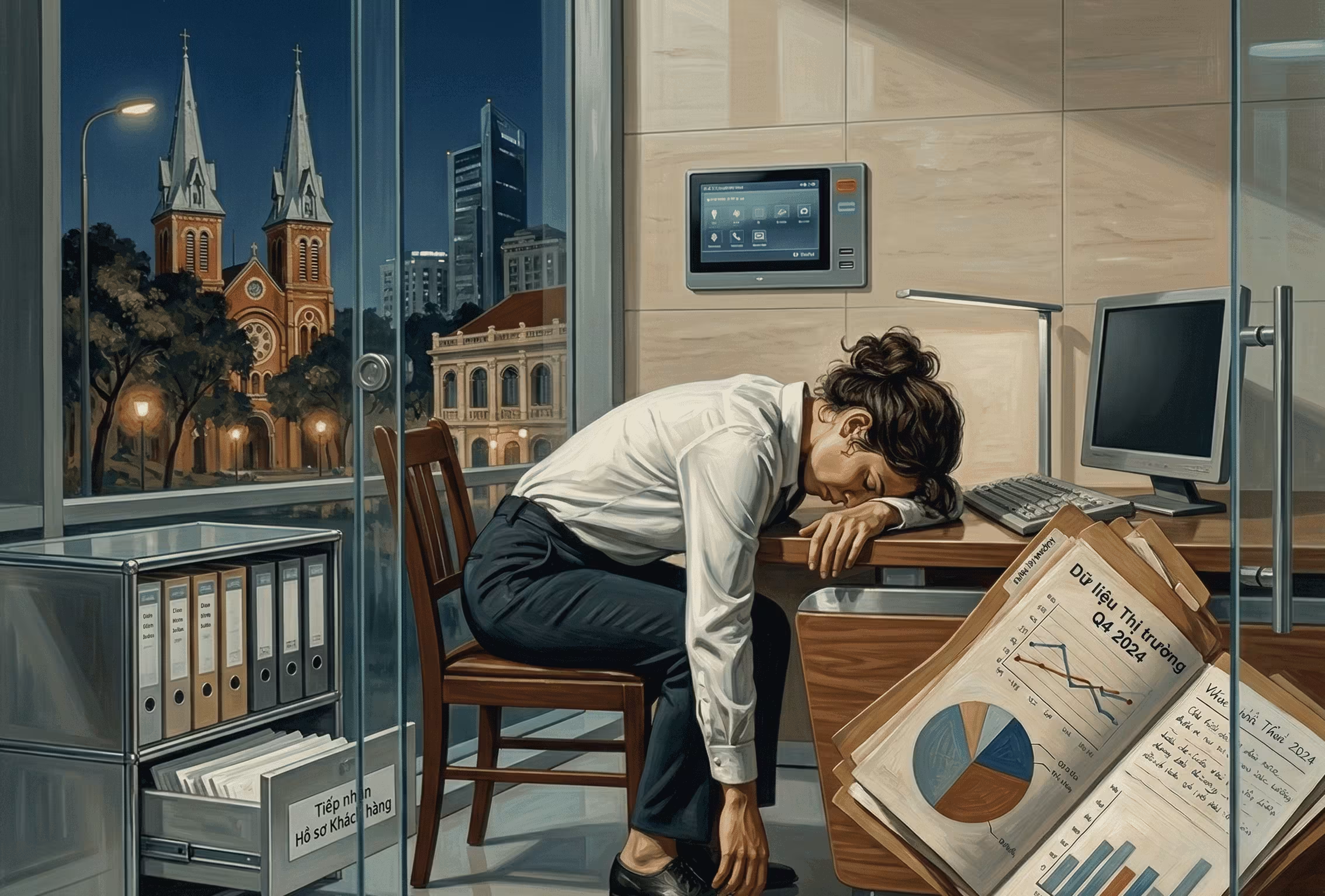
To recover from work burnout, you must reset your nervous system by establishing strict workload boundaries, practicing a strategic no, and ensuring deep sleep. Calming chronic stress requires deliberate changes, such as taking regular screen free breaks, adjusting daily routines for energy optimization, and reclaiming control over your environment to restore depleted power.
Recovering from work burnout requires more than just a long weekend of rest. It is a state where your internal battery has simply run out of power. This happens when you deal with stress that never seems to end. You might feel physically drained and mentally checked out from your daily tasks.
Why recovering from work burnout feels so difficult
You may feel like a stranger to yourself or the people you help. This is often a way your mind creates a wall to protect you. It is like a fuse that blows to prevent a house fire. Your brain creates distance because it can no longer handle the heat of the situation.
This condition often feels like an empty mental gas tank. Your body’s internal alarm system stays on for too long. Eventually, your system shuts down to save what little energy remains. You might find it hard to think clearly or remember simple details.
Practical steps for recovering from work burnout
You can start to heal by looking at your environment. Heavy workloads and a lack of control often cause this total shutdown. Try to identify which tasks drain you the most. You may feel like a fraud even when you are doing well. This common fear often drives us to work past our limits.
Start by setting small boundaries in your daily routine. Practice saying no to small tasks that do not truly matter. This allows you to protect your remaining energy for what is necessary. You can also try simple breathing exercises to calm your internal alarm system.
Focus on getting enough sleep to help your brain clean itself. Rest allows your mind to repair the damage from chronic stress. You might also look into ways to change how you work. Small shifts in your responsibilities can make a huge difference over time.
Try this today
Look at your to-do list for the next twenty-four hours. Choose one task that is not urgent or helpful and practice the strategic no. Simply decide that you will not do it today. This small act of control helps your mind feel safe again.
Spend five minutes sitting quietly without any digital screens. Focus only on the rhythm of your own breathing. This helps your body realise the immediate danger has passed. Repeat this three times a day to lower your stress levels.
Finally, try to adjust one small part of your daily routine. Move a difficult task to a time when you have more energy. Or, choose to eat your lunch away from your desk. These tiny changes help you regain a sense of power over your life.
Burnout rarely lifts through willpower alone, and it is often easier to unpick with someone else in the room. If you would like support, I offer individual therapy in Ho Chi Minh City and online. You are welcome to get in touch.
References
Biaigo, K., Ray, S., & Ahmed, S. I. (2025). Academic burnout and coping strategies in healthcare students: A scoping review. Medical Education Online, 30(1), 2579392.
Day, A. (2025). Appendix D: Breaking the Burnout Cycle: Building Organizational Strategies to Address Burnout Sources and Symptoms. In P. Whitacre & K. Wullert (Eds.), Impact of Burnout on the STEMM Workforce: Proceedings of a Workshop. National Academies Press (US).
Edú-Valsania, S., Laguía, A., & Moriano, J. A. (2022). Burnout: A Review of Theory and Measurement. International Journal of Environmental Research and Public Health, 19(3), 1780.
Han, J.-H., Lee, M., Cha, C., & Baek, G. (2025). Effects of Third-Wave Cognitive Behavioural Therapy for Healthcare Professionals’ Burnout: A Systematic Review and Meta-Analysis. Healthcare, 13(24), 3253.
Hedrih, V. (2026). Study links burnout and perfectionism to imposter phenomenon in psychiatrists. PsyPost.
Jin, X. (2025). Keyora Nutritional Neurology – Magnesium Glycinate · Episode 7: The Systemic Collapse: A Unified Theory of Burnout and the Systemic Solution Required. Technical Report.
LeBlanc, N. J., & Marques, L. (2019). How to handle stress at work. Harvard Health Publishing.
Malik, H. M., & Annabi, C. A. (2022). The impact of mindfulness practice on physician burnout: A scoping review. Frontiers in Psychology, 13, 956651.
Mei, Z., Cai, C., Wang, T., Luo, S., Yang, Y., Lam, C., Wang, Z., & Luo, S. (2025). The relationship between resilience and burnout in elite athletes: the mediating role of coping strategies and the moderating role of psychosocial resources. BMC Psychology, 13, 1248.
The High-Achiever’s Crisis: A Systematic Analysis of Burnout Etiology, Physiological Mechanisms, and Interventional Resilience. (n.d.).