
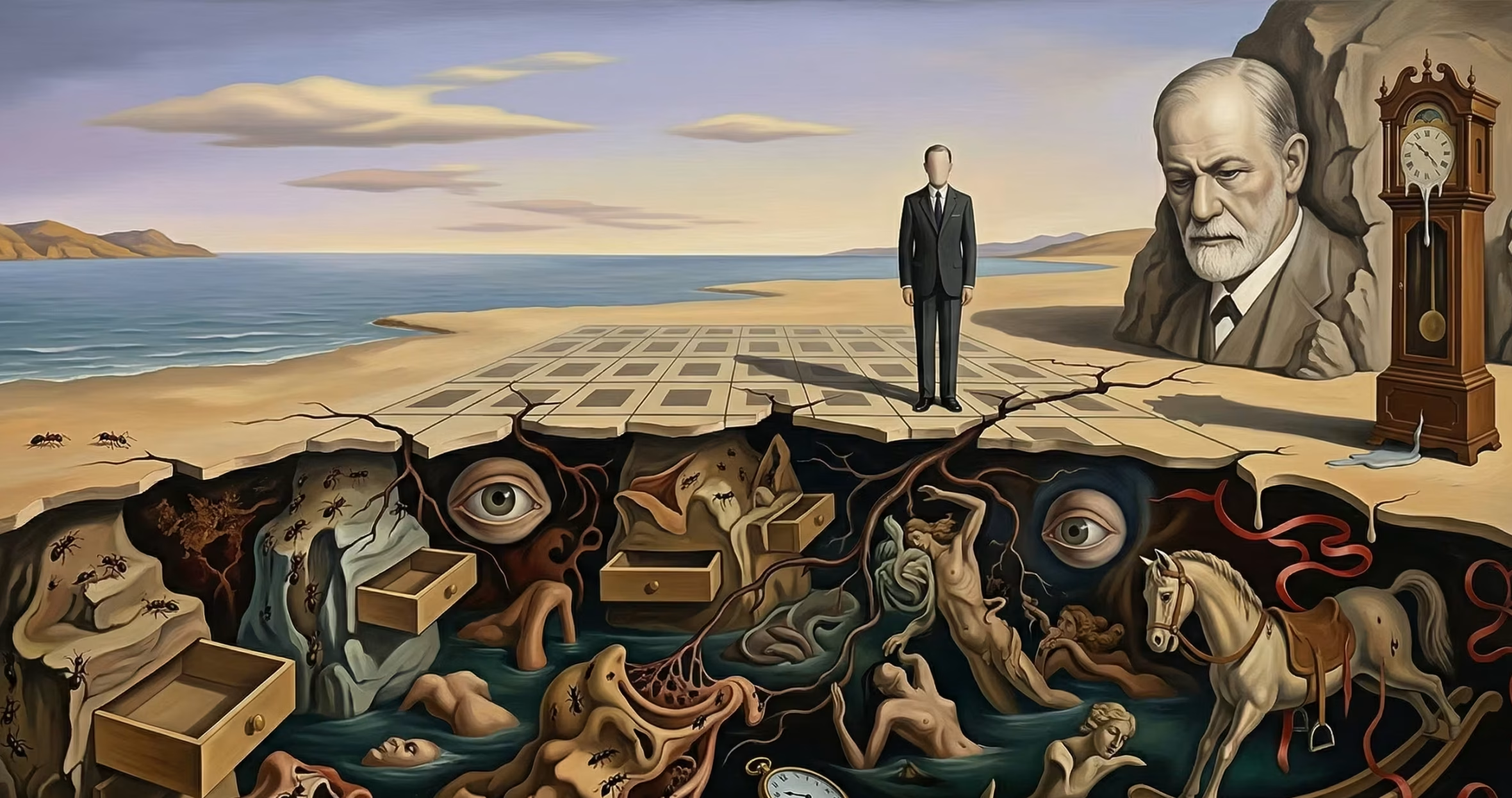
The discovery of the unconscious mind began when Sigmund Freud realised that physical symptoms stem from psychological causes instead of biological damage. By analysing hysteria, identifying emotional repression, and interpreting dreams through free association, Freud mapped a hidden psychic reality where suppressed desires and unacceptable thoughts actively shape human behaviour.
Discovery of the unconscious was not a straight line; it was a journey paved with frustration, contradiction, and radical shifts in perspective. Most people know Sigmund Freud as the father of psychoanalysis, but he began his career as a neuroscientist. He eventually broke away from the idea that humans are purely rational, self-knowing beings.
To understand how Freud became the “cartographer of the mind,” we must look at three critical turning points. These breakthroughs allowed him to unearth the dynamic depths hidden beneath our conscious thoughts.
How the Discovery of the Unconscious Began in Paris
Freud’s original training in Vienna was focused strictly on biology and anatomy. He believed that all illnesses must have a physical cause in the body’s tissues. This changed in 1885 when he studied under the neurologist Jean-Martin Charcot in Paris.
Charcot showed Freud that “hysteria” could cause physical symptoms (like a hand going numb) that had no biological explanation. This suggested that the disorder lived in the patient’s thoughts, not their nerves. This encounter was a vital step in the discovery of the unconscious. It taught Freud that physical pain could be caused by hidden psychological ideas.
Repression: A Pillar in the Discovery of the Unconscious
While working with Josef Breuer, Freud explored the “talking cure.” They found that patients felt better when they spoke about original traumatic events. While Breuer thought this happened because patients were in a “trance,” Freud saw something more active.
He realised that patients often resisted certain memories because the thoughts were too disturbing or unacceptable. Freud called this process repression. He noticed that whenever he tried to help a patient reach a memory, he faced a powerful “resistance.” This resistance proved that a hidden realm existed in the mind where we store thoughts we aren’t ready to face.
The Shift to Psychic Reality and Dreams
Initially, Freud thought all repressed memories were about real events. However, he soon realised that many of these “memories” were actually wishes or fantasies. This was a revolutionary moment. He concluded that psychic reality (what we feel and imagine) is just as important as what actually happened.
This led Freud to use free association, where patients say whatever comes to mind without filtering. This technique unlocked the “secrets” of dreams. Freud discovered that dreams are often disguised fulfillments of our deepest, hidden wishes.
Try This Today: Mapping Your Own Mind
Identify Your “Resistances”: Notice when you suddenly want to change the subject in a conversation. What feeling are you trying to avoid?
The “Why” Behind the Action: Next time you have a strong reaction to something small (like a text message), ask: “What internal feeling is driving this reaction?”
Dream Journaling: Write down your dreams for three nights. Don’t look for logic; instead, look for the feeling the dream left you with.
References
Aqsa Maheen, & Poznjakova, O. L. (2025). The depths of being: Freud’s unconscious and its philosophical legacy. (O. L. Poznjakova, Tutor). Belarusian State Medical University.
Beyond the Pleasure Principle. (n.d.). Open School East.
Breuer, J. (1893). Fräulein Anna O, Case histories from Studies on hysteria. In The standard edition of the complete psychological works of Sigmund Freud, Volume II (1893–1895): Studies on hysteria (pp. 19–47).
Breuer, J., & Freud, S. (1893). On the psychical mechanism of hysterical phenomena: Preliminary communication from Studies on hysteria. In The standard edition of the complete psychological works of Sigmund Freud, Volume II (1893–1895): Studies on hysteria (pp. 1–17).
Cieri, F., & Esposito, R. (2019). Psychoanalysis and neuroscience: The bridge between mind and brain. Frontiers in Psychology, 10, 1790. https://doi.org/10.3389/fpsyg.2019.01983
Dyer, R. (2023). Josef Breuer and Sigmund Freud’s Studies on Hysteria 1893, 1895. The Victorian Web.
Freud, S. (1917). The history of the psychoanalytic movement (A. A. Brill, Trans.). Nervous and Mental Disease Pub. Co. (Original work published 1914).
Mitchell, S. A., & Black, M. J. (1996). Freud and beyond: A history of modern psychoanalytic thought. Basic Books.
Sinatora, F., & Mezzalira, S. (2021). Freud’s concept of “Trieb”. A psychoanalytical account of its antinomic nature. International Journal of Psychoanalysis and Education, 1(2). https://doi.org/10.32111/SAS.2021.1.2.3
Smith, D. L. (2017, August 10). Before fathering psychoanalysis, Freud first slayed the dominant Cartesian intellectual tradition of mind-body dualism. Aeon.
Yılmaz, Y. A. (2021). Freud’s encounter with Charcot and his epistemological break. USBAD Uluslararası Sosyal Bilimler Akademi Dergisi – International Journal of Social Sciences Academy, 3(6), 887–908. https://doi.org/10.47994/usbad.896740
These ideas still shape how I work today. You can read more about my training and approach, or see the therapy services I offer in Ho Chi Minh City and online.