
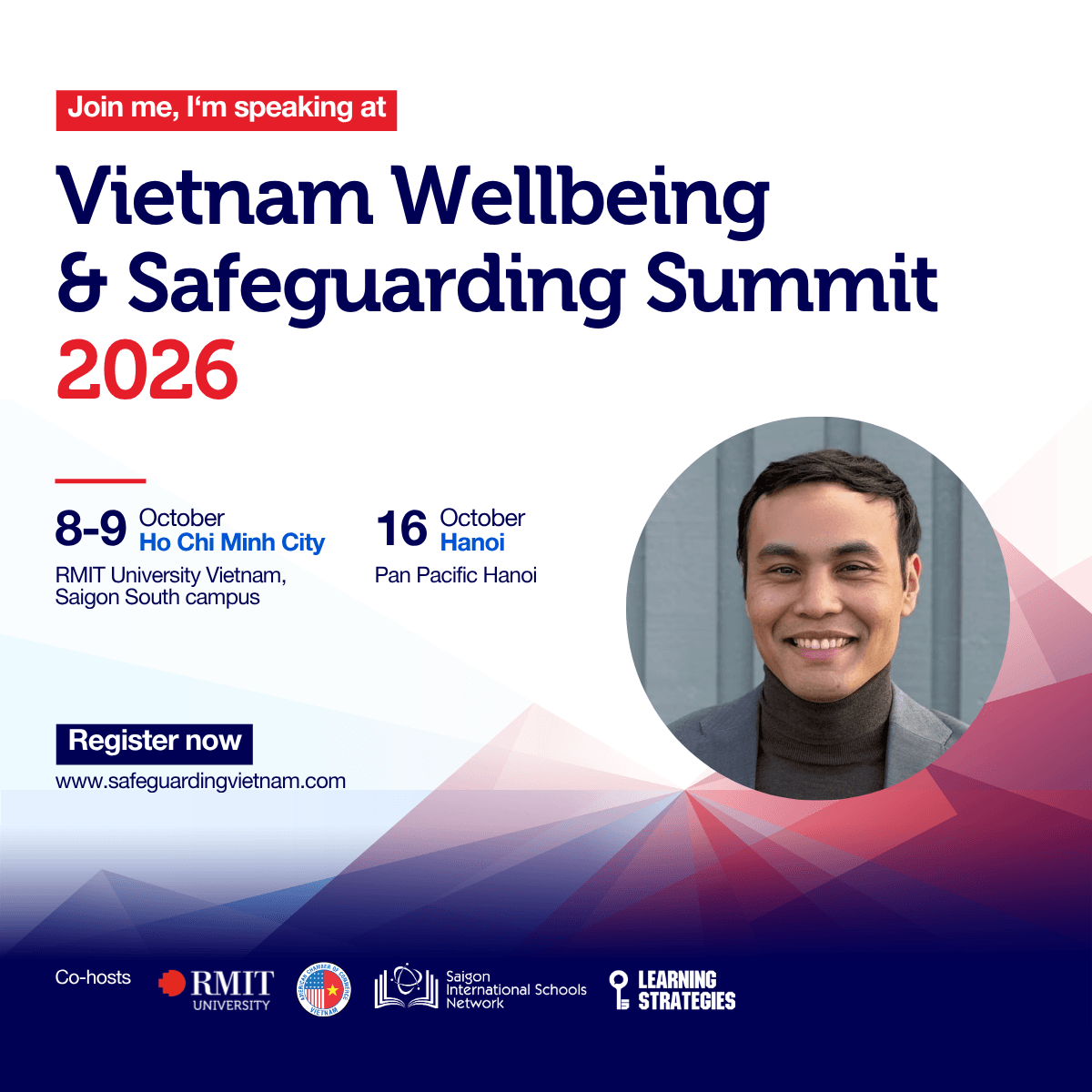
On 8 October 2026, I spoke at the Vietnam Wellbeing & Safeguarding Summit 2026, held 8–9 October at RMIT University Vietnam’s Saigon South campus in Ho Chi Minh City, which brought together educators, counsellors and school leaders. The summit was co-hosted by RMIT University, the American Chamber of Commerce in Vietnam, the Saigon International Schools Network and Learning Strategies. I was invited to give a talk titled “The Power of the Group: Transforming Student Wellbeing Through Shared Experience”, a practical framework for running groups in schools.
The pressure students are under
Students today carry a lot at once: high academic expectations, frequent moves between schools and countries, and, for many in international schools, the complexity of growing up as a Third Culture Kid. Most schools offer some counselling, but clinical resources are often stretched. What is usually missing is something in between: support that reaches more students than one-to-one work can, without becoming a general classroom programme.
Groups as the middle tier
I find it helpful to think of school support in three tiers. The first is universal: social-emotional learning, awareness campaigns and staff training that reach every student. The third is intensive: individual therapy, crisis response and specialist referral for the few students who need it. Groups belong in the middle, for students who need more than the universal offer but not intensive individual care.
A small group of peers offers something individual work cannot. Students discover that others recognise what they are going through, which eases shame and isolation. And the group becomes a real-time laboratory for relationships. If social-emotional learning teaches the “what”, the group is where students practise the “how”.
Who the group is for
A group works best when it is put together with care. In screening, I look for some capacity to reflect on one’s own feelings and behaviour, some motivation to take part, and the absence of an acute crisis that needs individual care first. Groups also tend to work better when members share a similar kind of difficulty. Examples include groups for transitions and loss (bereavement, parental divorce, relocation, friends leaving mid-year), for relational patterns and boundaries, for shyness and anxiety, and for neurodivergent students working on perspective-taking and conversational reciprocity.
Just as important is knowing who a group is not right for. Students with severe behavioural difficulties, high clinical complexity, or needs that make it hard to share a conversation are usually better served individually.
Mentalizing together
The groups I described are built on mentalization-based treatment for adolescents (MBT-A). Mentalizing is the capacity to understand our own and others’ actions in terms of what is going on inside: thoughts, feelings, needs and intentions. In each session, one member’s experience becomes the focus, and the rest of the group practises trying to understand it.
Here is an illustrative example of what that can look like. A student who has changed schools many times describes feeling like an outsider in the cafeteria. Instead of only responding to him, the group conductor turns to the others and asks whether anyone recognises that feeling. A student who has been at the same school for years answers that she felt exactly the same when her friendship group dropped her. In that moment, an isolating experience becomes a shared one.
The role of the group conductor
The person leading the group, the group conductor, does not need to have the answers. What matters more is a curious, “not-knowing” stance: being open about one’s own mistakes and showing how to repair them, keeping the emotional temperature at a level where thinking is still possible, and gently questioning certainties. When a student is convinced that a classmate is provoking them on purpose, or that a friend who hasn’t texted back no longer cares, the conductor invites the group to slow down and consider what else might be going on in the other person’s mind.
Experiencing a group, not just hearing about it
Groups are hard to understand from the outside, so the talk ended with an experiential group: 45 minutes of free-form, unstructured time for participants to experience a group from the inside.
An invitation
Groups are not a replacement for individual care, but they are a scalable, evidence-informed way to reach more students within the school itself, where young people actually spend their days. If you work in a school and are thinking about starting groups, I would be glad to hear from you through my contact page.
Thank you to the organisers of the Vietnam Wellbeing & Safeguarding Summit 2026 for the invitation.